
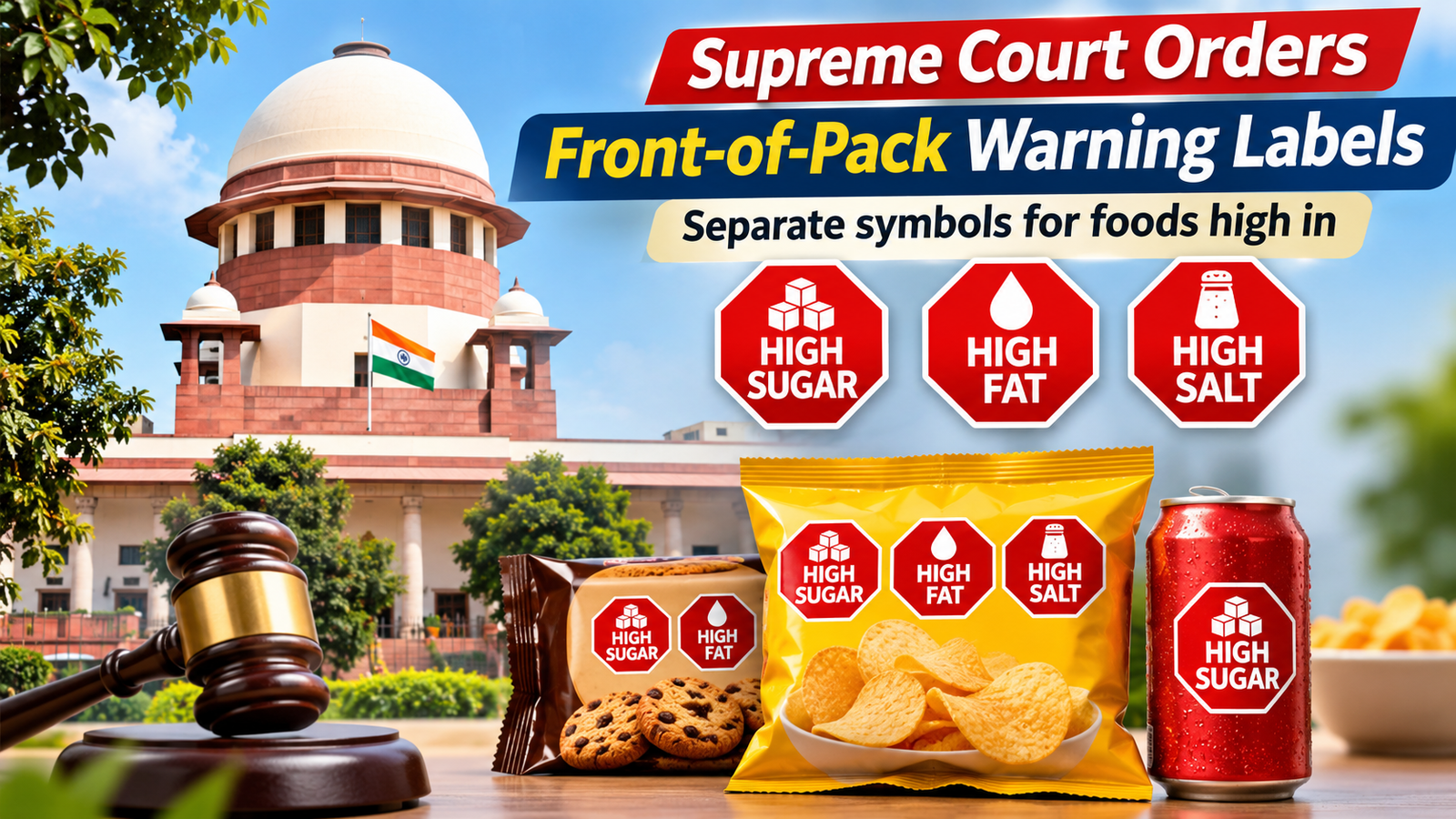
India's food labelling system may be entering an important phase of change. On 26 November 2026, the Supreme Court of India issued significant directions to the Central Government and the Food Safety and Standards Authority of India (FSSAI) regarding Front-of-Pack Nutrition Labelling (FoPNL). The directions aim to make it easier for consumers to identify packaged foods containing excessive amounts of sugar, fat and salt.
The Court directed that separate warning symbols should be displayed for each nutrient of concern rather than combining multiple warnings into a single symbol. It also directed FSSAI to consider total sugars and saturated fat instead of only added sugar and added fat when establishing the nutritional warning thresholds.
This development is particularly important for a country where obesity, type 2 diabetes, hypertension and cardiovascular diseases are major public-health concerns. Millions of people purchase packaged foods every day, but not everyone understands how to interpret the nutritional information printed on the back of food packets.
A simple warning symbol could make this information more accessible.
But what exactly is front-of-pack nutrition labelling? Why did the Supreme Court intervene? What is the difference between total sugar and added sugar? How could these changes affect Indian consumers and food manufacturers?
Let's examine the science, regulations and public-health implications.
1. What Is Front-of-Pack Nutrition Labelling?
Front-of-Pack Nutrition Labelling, commonly known as FoPNL or FOPNL, refers to nutritional information displayed prominently on the front of packaged food products.
Traditionally, manufacturers provide nutritional information on the back or side of food packaging. These nutrition information panels generally contain:
Energy (kcal)
Total fat
Saturated fat
Trans fat
Carbohydrates
Total sugars
Added sugars
Protein
Sodium
Although this information is valuable, consumers may find it difficult to interpret the numbers, understand serving sizes and compare different products.
For example, imagine purchasing two packets of breakfast cereal. Both may have attractive packaging and claims such as multigrain, nutritious or energy-rich. However, one product may contain considerably more sugar and sodium than the other.
Without comparing their nutrition labels, consumers may not recognise these differences.
Front-of-pack labelling attempts to simplify this process by presenting important nutritional information through prominent symbols, colours, words or numerical indicators.
The objective is simple: consumers should be able to recognise important nutritional concerns before purchasing a product.
Front-of-pack warning labels are intended to improve transparency, not automatically classify every packaged food as unhealthy.
2. What Did the Supreme Court Decide on 26 November 2026?
The Supreme Court issued directions in the case of 3S and Our Health Society versus Union of India, concerning the implementation of front-of-pack nutrition labelling in India.
The bench comprised Justice J. B. Pardiwala and Justice K. Vinod Chandran.
The Court addressed several aspects of the proposed FSSAI framework.
A. Separate warning symbols for each nutrient
One of the most important directions concerns the design of warning labels.
The Court directed that packaged food products should carry separate hexagonal warning symbols for each nutrient exceeding the prescribed threshold.
The warnings should include:
HIGH FAT
HIGH SUGAR
HIGH SALT
Each warning should have its own standardised pictorial representation.
For example, if a product exceeds the prescribed thresholds for both sugar and salt, it should display two separate warnings rather than combining both into one hexagon.
This approach is intended to make individual nutritional concerns easier to recognise.
B. Total sugars instead of only added sugar
The Court directed FSSAI to consider total sugars rather than only added sugar when determining the relevant warning thresholds.
This is a significant nutritional distinction because total sugars include naturally occurring sugars as well as added sugars.
C. Saturated fat instead of added fat
The Court also directed FSSAI to consider saturated fat rather than added fat as a nutrient of concern.
The distinction is important because added fat describes the introduction of fat during manufacturing, whereas saturated fat describes a particular type of fatty acid.
D. Recalculation of nutritional thresholds
FSSAI must revisit and reformulate the thresholds used to determine whether a food product requires a warning.
These thresholds should be scientifically justified and should reflect the nutritional concerns identified by the Court.
E. Size and visibility of warning labels
The Court directed that each warning hexagon should occupy approximately 4–5% of the principal display panel of the food package.
The warning words and pictograms should be prominent and easily readable.
F. Nutritional education for children
The Court also emphasised the importance of nutritional literacy among children.
It directed the government to consider appropriate school curriculum changes and practical educational opportunities, including interactive workshops and co-curricular activities.
These directions recognise that nutrition education should begin early in life.
These are directions for the regulatory framework; they should not be confused with a claim that every food packet already has to carry the new labels. FSSAI must complete the necessary regulatory process.
3. Why Are High Sugar Foods a Public-Health Concern?
Sugar is a carbohydrate that provides approximately 4 kcal per gram.
The body uses glucose as an important energy source, and carbohydrates are an essential component of many dietary patterns.
However, the quantity, source and frequency of sugar consumption matter.
Frequent consumption of foods and beverages high in free sugars can contribute to excessive energy intake and increase the risk of dental caries.
Sugar-sweetened beverages deserve particular attention because they can provide substantial calories without producing the same degree of satiety as many solid foods.
Excessive energy intake over time can contribute to weight gain and obesity.
Obesity is associated with increased risk of several metabolic and cardiovascular conditions, including:
Type 2 diabetes
Hypertension
Dyslipidaemia
Cardiovascular diseases
Fatty liver disease
Understanding total sugar, added sugar and free sugar
These terms are often used interchangeably, but they have different meanings.
Total sugars: Include all mono- and disaccharides present in a food, including naturally occurring and added sugars.
Added sugars: Sugars introduced during food processing, manufacturing or preparation.
Free sugars: Include added sugars and sugars naturally present in honey, syrups, fruit juices and fruit juice concentrates.
For example, plain milk contains naturally occurring lactose. Sweetened flavoured milk contains lactose as well as added sugar.
Both contribute to total sugar, but their added sugar quantities differ.
This distinction helps explain why considering total sugars can provide a broader assessment of the sugar content of packaged food.
However, total sugar content alone does not establish whether a food is healthy or unhealthy. Whole foods and dairy products may naturally contain sugars alongside important nutrients.
4. Why Is High Saturated Fat Consumption a Concern?
Dietary fat is an essential macronutrient. It provides energy, supports cell membrane structure, helps absorb fat-soluble vitamins and participates in hormone production.
However, the type of dietary fat is important.
Saturated fats are fatty acids that contain no carbon-carbon double bonds in their hydrocarbon chains.
Common sources include:
Butter
Ghee
Fatty meat
Full-fat dairy products
Palm oil
Coconut oil
Certain bakery products
High consumption of saturated fat can increase LDL cholesterol in many individuals, particularly when it replaces unsaturated fats in the diet.
Elevated LDL cholesterol is an established risk factor for atherosclerotic cardiovascular disease.
Added fat versus saturated fat
Added fat refers to fat introduced during food preparation or manufacturing.
Saturated fat refers to a specific type of fatty acid.
For example, olive oil is predominantly rich in monounsaturated fat, while butter contains a substantial amount of saturated fat.
Therefore, measuring only added fat does not provide sufficient information about the saturated fat content of a food product.
This explains why saturated fat is an important consideration in the proposed warning framework.
5. Why Is Excessive Salt Consumption Dangerous?
Salt is composed primarily of sodium chloride.
Sodium plays important physiological roles, including:
Maintaining fluid balance
Supporting nerve impulse transmission
Helping muscles contract
Maintaining normal cellular function
However, excessive sodium consumption can increase blood pressure in many individuals.
Long-term high blood pressure increases the risk of cardiovascular and kidney diseases.
Common sources of excessive sodium in Indian diets include:
Instant noodles
Packaged namkeen
Salted biscuits
Processed meat
Pickles
Ready-to-eat meals
Packaged sauces
Certain savoury snacks
One important point is that consumers may not always recognise high-sodium foods because many products do not taste particularly salty.
Reducing excessive sodium consumption is therefore an important public-health measure.
6. Why Is Reading the Back of a Food Packet Not Always Enough?
Traditional nutrition information panels provide detailed nutritional information, but consumers need to understand serving sizes, nutrient quantities and daily nutritional requirements.
Consider the following hypothetical example of a packaged snack.
| Nutrient | Quantity per 100 g |
|---|---|
| Energy | 520 kcal |
| Total fat | 32 g |
| Saturated fat | 14 g |
| Total sugars | 8 g |
| Sodium | 650 mg |
| Protein | 6 g |
A consumer might focus only on the protein content or calorie information and overlook the saturated fat and sodium levels.
Another challenge is serving size.
A product may display nutritional information per 30 g serving, although consumers commonly eat 60–100 g at a time.
Consequently, consumers may underestimate their actual nutrient intake.
Front-of-pack warnings can make important nutritional information easier to identify before purchasing a product.
However, they should complement, not replace, the detailed nutrition information panel.
7. How Could These Warning Labels Change Food Purchasing Behaviour?
The main objective of warning labels is to improve consumer awareness at the point of purchase.
Imagine walking into a supermarket and seeing three packets of breakfast cereal.
All three have attractive packaging and health-related marketing messages. However, their nutritional compositions differ.
With clear front-of-pack warning labels, consumers could identify products exceeding the prescribed nutrient thresholds more quickly.
This may help consumers:
Compare similar products.
Identify foods high in sugar.
Recognise products high in saturated fat.
Identify products containing excessive salt.
Question misleading health-related marketing impressions.
Make more informed purchasing decisions.
Warning labels do not guarantee healthier food choices, but they can reduce the effort required to understand important nutritional information.
8. What Does This Mean for Food Manufacturers?
The introduction of mandatory warning labels could influence the food manufacturing industry.
Manufacturers may need to review the nutritional composition of their products.
Potential changes could include:
Reducing excessive added sugars.
Reformulating products to improve their fatty acid composition.
Reducing sodium content.
Improving nutritional transparency.
Reviewing front-of-pack marketing claims.
Updating packaging designs.
Strengthening nutritional quality control.
This process is often called product reformulation.
For example, a manufacturer producing instant noodles may explore ways to reduce sodium without significantly affecting product quality and consumer acceptance.
Similarly, a breakfast cereal manufacturer may consider reducing added sugars.
However, reformulation must be carefully monitored. Reducing one nutrient should not result in excessive use of other ingredients or additives that create different nutritional or safety concerns.
9. Are Front-of-Pack Warning Labels Already Mandatory in India?
No. Consumers should understand the difference between a Supreme Court direction and the final implementation of revised FSSAI regulations.
The Supreme Court has directed FSSAI and the Central Government to move forward with an effective front-of-pack warning framework.
FSSAI must complete the necessary regulatory process, including preparation of draft regulations and the prescribed consultation process.
The final regulatory notification will establish the applicable nutrient thresholds, exemptions, labelling requirements and implementation timeline.
Therefore, consumers should not assume that every packaged food product must immediately display the new red hexagonal warnings.
10. What Is the Role of FSSAI?
The Food Safety and Standards Authority of India is India's national food safety regulator.
It was established under the Food Safety and Standards Act, 2006.
Its responsibilities include:
Establishing science-based food standards.
Regulating food manufacturing and distribution.
Monitoring food safety.
Developing food labelling requirements.
Regulating food businesses.
Promoting consumer awareness about food safety.
The Food Safety and Standards (Labelling and Display) Regulations, 2020, provide an important existing regulatory framework for food labelling in India.
The revised front-of-pack warning framework will require appropriate regulatory action by FSSAI.
11. International Examples: How Other Countries Use Front-of-Pack Warning Labels
India is not the first country to explore interpretive warning labels.
Several countries have introduced front-of-pack systems to help consumers identify products containing high quantities of specific nutrients.
Chile
Chile introduced prominent black octagonal warning labels for packaged products exceeding specified thresholds for calories, sugar, sodium and saturated fat.
The system also includes restrictions concerning marketing to children and other measures.
Mexico
Mexico introduced a front-of-pack warning system using black octagonal symbols to identify products exceeding specified nutritional thresholds.
The system also includes additional warning statements for certain ingredients.
Canada
Canada has introduced a front-of-package nutrition symbol for foods high in saturated fat, sugars and sodium.
These international examples demonstrate different ways of communicating nutritional information.
India's proposed red hexagonal warning approach is another effort to make nutritional risks easier to recognise.
However, regulatory thresholds and implementation requirements differ between countries.
12. Will Warning Labels Make Packaged Foods Unhealthy?
No.
A warning label does not automatically mean that a food product is poisonous or unsafe.
It indicates that the product exceeds a specified regulatory threshold for one or more nutrients of concern.
The overall nutritional quality of a food depends on several factors:
Nutrient composition.
Portion size.
Frequency of consumption.
Processing.
Dietary diversity.
Individual nutritional requirements.
Overall dietary pattern.
For example, a product may carry a high-salt warning but still provide protein or other nutrients.
That does not cancel out the significance of its sodium content.
Similarly, a product without warning labels should not automatically be considered nutritionally complete or healthy.
Consumers must learn to evaluate the overall nutritional profile rather than relying on one symbol alone.
13. What Should Indian Consumers Do While Buying Packaged Food?
Until the revised regulations are fully implemented, consumers can start developing better food-label reading habits.
1. Check the serving size
Do not assume that the nutritional values represent the entire packet.
2. Check total sugars
Look beyond marketing terms such as natural, healthy or energy-rich.
3. Check saturated fat
Compare similar products and pay attention to saturated fat content.
4. Check sodium
Remember that sodium is present in many packaged products, including savoury snacks, instant meals and sauces.
5. Compare similar products
Choose products with a more suitable nutritional profile for your dietary requirements.
6. Avoid being influenced only by front-pack claims
Words such as multigrain, high protein, natural and fortified do not automatically mean that a product is low in sugar, saturated fat or sodium.
7. Consider portion size and frequency
Even foods with a relatively favourable nutritional profile can contribute to excessive calorie intake when consumed in large quantities.
14. Why Should Nutrition Literacy Begin in Schools?
One important aspect of the Supreme Court's directions is the emphasis on nutritional literacy among children.
Children are regularly exposed to advertisements for packaged snacks, sweetened beverages and other processed foods.
However, many children do not have sufficient knowledge to understand nutrition labels.
Nutrition education should therefore include practical activities.
Schools can teach children:
How to read a food label.
How to identify added sugars.
How to understand saturated fat.
Why excessive sodium consumption is a concern.
How to compare two packaged products.
Why whole foods should form an important part of a balanced diet.
Interactive activities can make nutrition education more effective than simply memorising definitions.
For example, teachers can ask students to compare the nutritional labels of two biscuit packets and identify which product contains more sugar or sodium.
Such activities can develop lifelong food awareness.
15. Can Front-of-Pack Labelling Help India Fight Non-Communicable Diseases?
India faces a growing burden of non-communicable diseases (NCDs), including obesity, type 2 diabetes, cardiovascular diseases and hypertension.
Diet is one of several important modifiable risk factors associated with these conditions.
Excessive consumption of foods high in free sugars, sodium and saturated fats can contribute to unhealthy dietary patterns.
However, NCD prevention requires more than nutritional warning labels.
A comprehensive public-health strategy should include:
Improved access to affordable nutritious foods.
Nutrition education.
Physical activity.
Better school food environments.
Responsible food marketing.
Improved food reformulation.
Stronger food safety regulation.
Regular health screening.
Access to preventive healthcare.
Front-of-pack labelling can be one useful component of this broader strategy.
It cannot independently eliminate obesity, diabetes or cardiovascular diseases.
Nevertheless, making nutritional information more accessible is an important step towards improving the food environment.
Conclusion
The Supreme Court's directions on 26 November 2026 represent an important development in India's food labelling debate.
By directing FSSAI to establish separate warnings for high fat, high sugar and high salt, the Court has placed greater emphasis on transparent nutritional information and informed consumer choices.
The directions concerning total sugars, saturated fat, warning-label visibility and nutritional education also highlight the importance of science-based food regulation.
However, the actual impact will depend on the final regulations, scientifically appropriate nutrient thresholds, effective enforcement and consumer awareness.
As nutrition professionals, we must encourage people to understand what they eat rather than relying entirely on attractive packaging and marketing claims.
Remember: A food package tells a story about what you are eating. Learning to read that story is an important part of protecting your health.
References and Further Reading
LiveLaw - Supreme Court directions on separate front-of-pack warning labels, 26 November 2026.
Hindustan Times - Supreme Court tightens food labelling norms and FSSAI timeline, 26 November 2026.
ThePrint / PTI - Supreme Court directions concerning total sugar and saturated fat, 26 November 2026.
NDTV - Supreme Court orders separate front-of-pack warning labels for foods high in fat, sugar and salt.
Reuters - Reporting on India's front-of-pack nutrition labelling developments.
Supreme Court of India - 3S and Our Health Society versus Union of India, Writ Petition (Civil) No. 437 of 2024.
Official Resources
FSSAI: https://www.fssai.gov.in/
FSSAI Regulations: https://www.fssai.gov.in/cms/food-safety-and-standards-regulations.php
World Health Organization – Healthy Diet: https://www.who.int/health-topics/healthy-diet
ICMR–National Institute of Nutrition: https://www.nin.res.in/
Supreme Court case background: https://indiankanoon.org/doc/53649368/
Disclaimer: This article is intended for educational and public-awareness purposes. The Supreme Court's directions should be distinguished from the final FSSAI regulations. Readers should refer to official notifications for the final requirements and implementation dates. This article does not replace individualised medical or dietary advice.






💬 Comments (0)
Be respectful. Website links and phone numbers are not allowed.