

Packaged drinking water is widely consumed in India because many people see bottled water as a convenient, safer alternative to untreated drinking water. From railway stations and restaurants to offices, hospitals, and households, packaged water has become a regular part of everyday life.
However, a recent food safety controversy involving one of India's best-known bottled water brands has brought renewed attention to the importance of drinking water quality and regulatory monitoring.
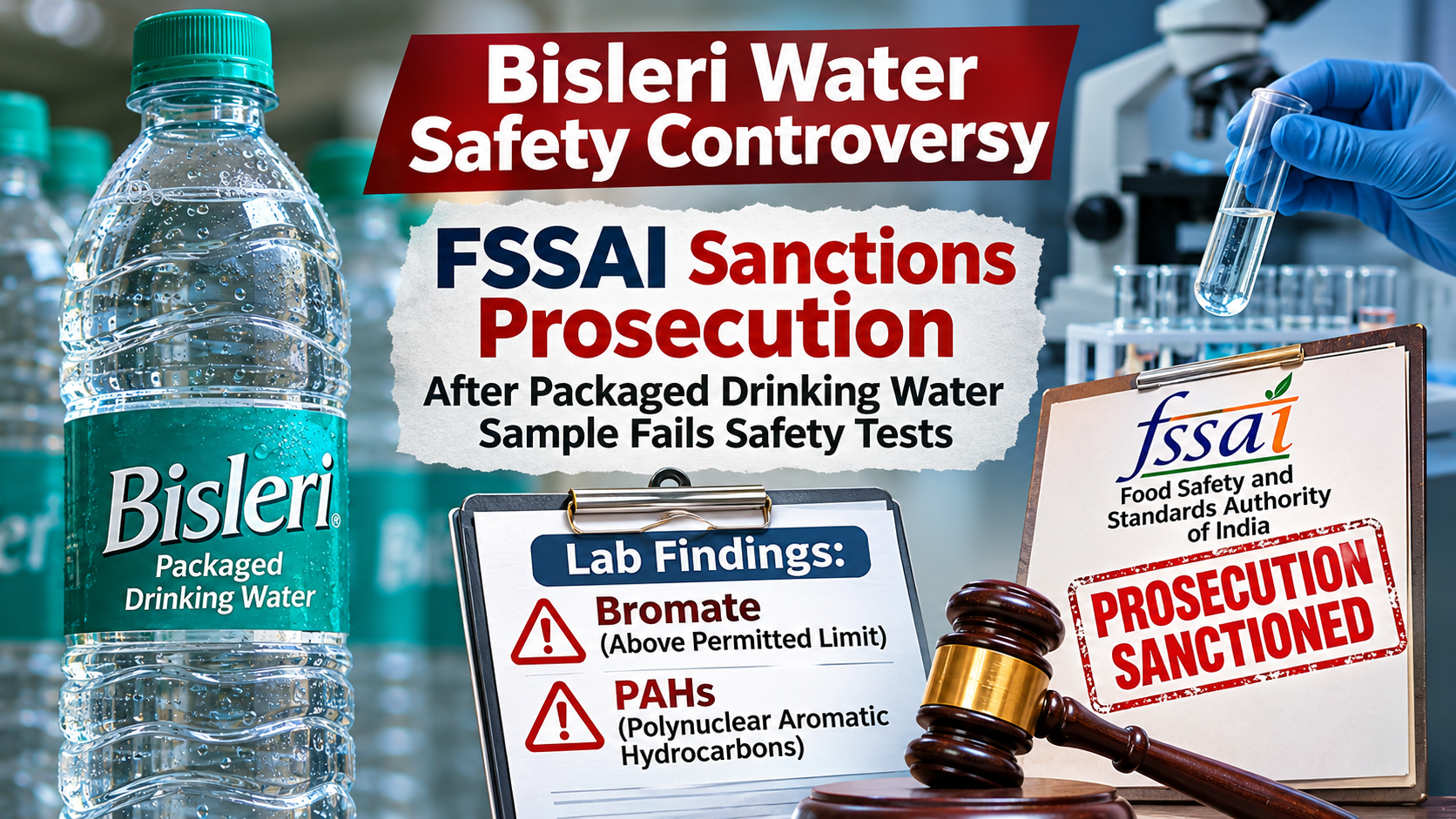
The Food Safety and Standards Authority of India (FSSAI) has sanctioned prosecution against Bisleri International Pvt. Ltd. after laboratory examinations found a regulatory sample of its packaged drinking water unsafe. The case involves two chemical contamination concerns: bromate and polynuclear aromatic hydrocarbons (PAHs).
According to the regulator, the initial laboratory examination found that the sample did not comply with the prescribed bromate limits. Following an appeal by the company, a referral food laboratory also declared the sample unsafe after detecting PAHs.
The development has raised important questions about water purification processes, chemical contamination, manufacturing quality control, and consumer awareness.
However, it is equally important to understand that the regulatory action concerns a specific sample and an identified production batch, not every bottle sold under the Bisleri brand.
1. What Happened in the Bisleri Water Safety Case?
On November 22, 2026, FSSAI announced that it had sanctioned prosecution against Bisleri International Pvt. Ltd. under the Food Safety and Standards Act, 2006.
The regulatory sample was categorised as "Packaged Drinking Water (other than Mineral Water)" and was collected from the company's premises for laboratory analysis.
According to FSSAI, the initial laboratory examination found that the sample was non-compliant with the prescribed bromate limits and was consequently declared unsafe.
The company challenged the initial findings through an appeal. The sample was subsequently referred to a Referral Food Laboratory for further examination.
The referral laboratory also declared the sample unsafe, citing the detection of polynuclear aromatic hydrocarbons (PAHs).
Following these laboratory findings, FSSAI sanctioned prosecution against the company under the applicable provisions of food safety legislation.
This case is significant because it highlights that drinking water safety is not determined solely by appearance, taste, smell, or brand reputation. Chemical contaminants may be present even when water appears clear.
2. Understanding the Bromate Contamination Concern
Bromate is a chemical compound containing bromine and oxygen. Its chemical formula is BrO₃⁻.
It is not a mineral that manufacturers intentionally add to drinking water for nutritional purposes. Instead, bromate can form as an unintended by-product during certain water disinfection processes.
How does bromate enter drinking water?
Ozonation is a commonly used water treatment method. Ozone is a powerful oxidising agent that helps disinfect water by controlling harmful microorganisms.
However, when ozone reacts with naturally occurring bromide ions in source water, bromate may form under certain conditions.
The formation of bromate depends on several factors, including:
The concentration of bromide in the original water.
The amount of ozone used during treatment.
Water pH.
Temperature.
Contact time between ozone and water.
Other water chemistry conditions.
This makes the control of ozonation an important part of packaged drinking water manufacturing.
What was the reported bromate level?
According to information reported about the Bisleri case, the initial laboratory test detected bromate at approximately 12 micrograms per litre (µg/L).
The prescribed limit is 10 µg/L.
Therefore, the initial reported result was above the permitted limit.
However, Bisleri subsequently stated that the referral laboratory found bromate within the prescribed limit. The referral examination separately identified PAHs, which became the basis for the unsafe classification.
This distinction is important because the two laboratory findings should not be presented as if both laboratories reported the same bromate result.
3. Why Is Bromate a Public Health Concern?
Bromate contamination is a recognised drinking water safety concern.
The International Agency for Research on Cancer (IARC) has classified potassium bromate as possibly carcinogenic to humans (Group 2B).
Research involving experimental animals has associated bromate exposure with tumour development, particularly in the kidneys and other tissues.
The World Health Organization (WHO) has established a guideline value of 0.01 mg/L (10 µg/L) for bromate in drinking water.
The purpose of this limit is to minimise long-term exposure and reduce potential health risks.
Does drinking water containing bromate immediately cause cancer?
No. This is an important distinction.
The detection of bromate above a regulatory limit does not mean that a person who drinks one bottle will immediately develop cancer.
Cancer risk is influenced by several factors, including:
Concentration of the contaminant.
Duration of exposure.
Frequency of consumption.
Total amount consumed.
Individual susceptibility.
Other environmental and lifestyle exposures.
The regulatory limit is intended to protect public health, particularly against repeated and long-term exposure.
The presence of a chemical above its prescribed limit should therefore be treated seriously without creating unnecessary panic.
4. What Are Polynuclear Aromatic Hydrocarbons (PAHs)?
The second major concern in the Bisleri case involves polynuclear aromatic hydrocarbons, commonly referred to as PAHs.
PAHs are a group of organic chemicals containing multiple fused aromatic rings.
They are commonly generated through the incomplete combustion of organic materials such as coal, petroleum, wood, and other fuels.
Some PAHs are recognised carcinogens, while others have different levels of toxicity.
How can PAHs contaminate water?
PAHs may enter the environment through:
Industrial emissions.
Vehicle exhaust.
Burning of fossil fuels.
Industrial wastewater.
Contaminated soil.
Atmospheric deposition.
Improper handling or storage of materials.
These substances can enter water sources through environmental contamination.
Their presence in drinking water is a concern because some members of this chemical group are associated with adverse health effects.
Are all PAHs equally harmful?
No.
This is a very important scientific distinction.
PAHs represent a large family of chemicals, and their health effects vary depending on their individual chemical structures.
For example, benzo[a]pyrene is a well-known carcinogenic PAH classified by IARC as carcinogenic to humans (Group 1).
Other PAHs may have different carcinogenic classifications or insufficient evidence for definitive classification.
Therefore, detecting PAHs does not automatically establish that every compound in the group is equally carcinogenic.
The specific compounds detected, their concentrations and the applicable regulatory requirements are essential for interpreting the health significance of a laboratory result.
5. What Did Bisleri Say About the Allegations?
Following the regulatory announcement, Bisleri International issued a response disputing aspects of the findings and maintaining that its packaged drinking water is safe for consumption.
According to the company's statement, the matter relates to samples collected from its Goa manufacturing facility on September 30, 2025.
Bisleri stated that FSSAI collected six samples from the facility.
According to the company's account:
Five samples reportedly complied with the applicable standards during initial testing.
One sample recorded bromate at 12 µg/L against the prescribed limit of 10 µg/L.
The company appealed against the initial laboratory findings on November 22, 2025.
The referral laboratory reportedly found bromate within the prescribed limit but separately detected PAHs.
Bisleri subsequently arranged independent testing of the same sample through an FSSAI-approved laboratory.
The company said that its independent testing also found bromate within the prescribed limit.
Bisleri further stated that it submitted its independent laboratory findings to FSSAI's Western Regional Office through a formal communication dated February 2, 2026.
The company also said that it had not received the reported prosecution notice and would cooperate with the authorities through the appropriate regulatory process.
Bisleri has highlighted its internal quality control procedures, stating that it conducts more than 90 quality checks across its 10-step manufacturing process.
These statements represent the company's position. They should be distinguished from the regulator's laboratory findings and enforcement action.
6. Important Clarification: Is Every Bisleri Bottle Unsafe?
No.
Consumers should not interpret this development as proof that every bottle of Bisleri packaged drinking water sold throughout India is unsafe.
FSSAI subsequently clarified that the non-compliance was limited to one sample from one production batch manufactured at the company's Goa facility.
The affected batch was identified as Batch No. GO 270.
The regulator also prohibited the sale of the affected batch and directed the company to conduct a root cause analysis.
This clarification is particularly important because a finding concerning one production batch cannot automatically be extended to all manufacturing facilities, all batches or every product sold by a company.
Consumers should follow official regulatory instructions concerning the affected batch rather than assuming that all packaged water from the brand has the same contamination problem.
7. What Does Sanctioning Prosecution Mean?
The Food Safety and Standards Act, 2006, provides the legal framework for regulating food safety in India.
FSSAI and the relevant state food safety authorities have responsibilities that include:
Monitoring food quality.
Conducting inspections.
Collecting regulatory samples.
Arranging laboratory examinations.
Investigating food safety violations.
Initiating appropriate enforcement action.
When FSSAI sanctions prosecution, it means that the regulator has authorised the initiation of legal proceedings under the applicable provisions of the Act.
However, sanctioning prosecution is not the same as a final judicial conviction.
The company is entitled to defend itself through the legal process, and the matter must be considered in accordance with the applicable law and evidence.
8. Why Is Packaged Drinking Water Safety Important in India?
India has a large and diverse packaged drinking water market.
People frequently depend on bottled water while travelling, working outdoors, eating at restaurants or living in areas where the quality of available drinking water is uncertain.
However, safe drinking water requires more than filtration and disinfection.
A properly manufactured product must meet applicable microbiological and chemical safety requirements.
Microbiological safety
Water may contain harmful microorganisms, including:
Escherichia coli (E. coli).
Coliform bacteria.
Certain pathogenic bacteria.
Viruses.
Protozoan parasites.
These microorganisms may cause gastrointestinal infections and other illnesses.
Chemical safety
Water may also contain unwanted chemical substances, including:
Arsenic.
Lead.
Nitrate.
Fluoride at excessive concentrations.
Bromate.
Certain pesticide residues.
Industrial chemical contaminants.
PAHs.
Some chemical contaminants can cause adverse health effects following prolonged exposure.
This is why chemical and microbiological testing are both essential for ensuring drinking water quality.
9. Does RO Purification Guarantee Completely Safe Drinking Water?
Reverse osmosis (RO) is an important water purification technology.
It uses a semi-permeable membrane to reduce many dissolved substances, salts and contaminants in water.
However, RO purification should not be considered a universal guarantee of complete safety.
The effectiveness of treatment depends on several factors:
Quality of the incoming water.
Membrane condition.
System maintenance.
Operating pressure.
Treatment design.
Post-treatment processes.
Storage and distribution hygiene.
Similarly, ultraviolet (UV) treatment and ozonation have specific purposes in water treatment.
UV is primarily used for microbial control, while ozone is a powerful disinfectant and oxidising agent.
However, water treatment processes must be carefully monitored because chemical reactions during treatment can sometimes generate unwanted by-products.
The bromate issue illustrates why manufacturers must control ozonation and regularly test the final product.
10. What Should Consumers Check Before Buying Packaged Drinking Water?
Consumers can follow some basic precautions when purchasing packaged drinking water.
Check the product category
Look for the exact product description on the bottle.
Packaged drinking water and packaged natural mineral water are separate regulatory categories in India.
Check the manufacturing details
Examine the manufacturing date, batch number, manufacturer details, and applicable licence information.
Check the seal
Avoid bottles with broken seals, damaged caps, or signs of tampering.
Avoid damaged packaging
Do not purchase bottles with unusual damage, leakage, or improper storage conditions.
Check official safety information
If a regulator announces a product recall or sale prohibition, follow the official instructions and check whether the bottle belongs to the affected batch.
Do not judge water only by appearance
Clear water is not necessarily chemically safe.
Some contaminants cannot be identified through smell, taste, or visual examination.
11. What Should Water Manufacturers Learn From This Case?
The Bisleri controversy highlights several important responsibilities for packaged drinking water manufacturers.
First, water sources should be regularly evaluated for chemical and microbiological contamination.
Second, treatment processes such as ozonation should be carefully controlled to prevent the formation of unwanted disinfection by-products.
Third, manufacturers should conduct regular testing through competent and appropriately accredited laboratories.
Fourth, finished products should undergo quality checks before distribution.
Finally, manufacturers should maintain transparent documentation of production batches, laboratory reports, corrective actions, and product traceability.
Regulatory sampling is also important because internal quality checks alone cannot replace independent monitoring.
12. Packaged Drinking Water vs Natural Mineral Water: What Is the Difference?
One important aspect of bottled water that consumers should understand is the difference between packaged drinking water and packaged natural mineral water.
Many consumers assume that every bottled water labelled as mineral water contains naturally occurring minerals. However, this is not necessarily true.
Under Indian food safety standards, packaged drinking water and packaged natural mineral water are two distinct product categories with different source, treatment, and composition requirements.
What Is Packaged Drinking Water?
Packaged drinking water is water that has been processed and treated to make it suitable for human consumption. It can originate from sources such as groundwater, surface water or municipal water, subject to applicable requirements.
The water may undergo several purification processes, including:
Filtration.
Reverse osmosis (RO).
Ultraviolet (UV) treatment.
Ozonation.
Other permitted purification and disinfection processes.
During RO purification, many naturally dissolved minerals may also be reduced or removed.
Manufacturers may subsequently add permitted minerals or mineral salts to the purified water to adjust its mineral composition and taste, in accordance with applicable standards.
For example:
| Mineral | Example of mineral salt |
|---|---|
| Calcium | Calcium chloride |
| Magnesium | Magnesium sulphate |
| Potassium | Potassium bicarbonate |
| Sodium | Sodium bicarbonate |
Therefore, when a bottle says "Packaged Drinking Water with Added Minerals", it generally means that selected minerals have been added during processing.
These added minerals do not make the product equivalent to naturally sourced mineral water.
What Is Packaged Natural Mineral Water?
Natural mineral water comes from a protected underground source and has a characteristic mineral composition resulting from its natural geological origin.
Unlike ordinary packaged drinking water, its mineral composition is naturally established by the source.
Its processing is restricted to specific permitted treatments that preserve its essential characteristics and microbiological quality.
Natural mineral water is not simply ordinary RO-treated water to which minerals are added afterwards.
Its identity depends on its natural source, characteristic composition and compliance with the applicable standards.
Key Differences Between the Two
| Parameter | Packaged Drinking Water | Packaged Natural Mineral Water |
|---|---|---|
| Source | Various suitable water sources | Protected underground source |
| Purification | May undergo RO, UV, ozonation, and filtration | Only permitted treatments |
| Mineral origin | Naturally present or added during processing | Naturally occurring |
| Mineral composition | Can be adjusted through permitted processing | Characteristic of the natural source |
| Mineral addition | Permitted subject to applicable standards | Cannot simply be artificially formulated to imitate natural mineral water |
| Main identity | Treated water suitable for drinking | Naturally sourced mineral-containing water |
Does Added Mineral Water Provide More Health Benefits?
Not necessarily.
The presence of added calcium, magnesium or potassium does not automatically make a bottled water product healthier.
The nutritional significance depends on the actual quantity of each mineral present in the finished product.
For example, a label stating "Added Minerals" does not tell consumers how much calcium or magnesium they are actually consuming.
Consumers should examine the mineral composition, including values expressed in milligrams per litre (mg/L), wherever these are provided.
It is also important to understand that TDS (Total Dissolved Solids) is not a direct measure of nutritional quality. TDS indicates the total concentration of dissolved substances, not how much of those substances are beneficial minerals.
Indian regulatory standards: Packaged drinking water is covered under BIS IS 14543, while packaged natural mineral water is covered under BIS IS 13428. FSSAI requirements and applicable amendments should also be considered.
What Should Consumers Remember?
The words "Added Minerals" and "Natural Mineral Water" do not mean the same thing.
Packaged drinking water can contain minerals added during manufacturing, whereas natural mineral water derives its characteristic mineral composition from a protected underground source.
Both categories can be safe for consumption when they comply with the applicable food safety standards.
The most important factor is not simply whether minerals are present, but whether the water meets the required chemical and microbiological safety standards.
12. Conclusion: Safe Drinking Water Requires More Than a Trusted Brand
The FSSAI action against Bisleri International has brought an important drinking water safety issue into public discussion.
The reported detection of bromate and PAHs in a regulatory sample highlights the importance of controlling chemical contamination during water sourcing, treatment, manufacturing, and packaging.
At the same time, the case should be understood accurately. The regulator's subsequent clarification identifies one affected production batch from the Goa facility, not the entire Bisleri product range.
The company's response and the regulatory findings should both be considered when reporting this development.
For consumers, the most important lesson is that drinking water safety cannot be judged by brand reputation, packaging or appearance alone.
Safe drinking water requires scientific testing, effective manufacturing controls, regulatory supervision, and transparent information.
Remember: Clean-looking water is not necessarily chemically safe water. Drinking water quality must be established through reliable laboratory testing.
Scientific and Regulatory References
Food Safety and Standards Authority of India (FSSAI). Food Safety and Standards Act, 2006, and applicable food safety regulations. https://www.fssai.gov.in/
World Health Organization (WHO). Guidelines for Drinking-water Quality. https://www.who.int/publications/i/item/9789240045064
International Agency for Research on Cancer (IARC). IARC Monographs on the Identification of Carcinogenic Hazards to Humans. https://monographs.iarc.who.int/
U.S. Environmental Protection Agency (EPA). National Primary Drinking Water Regulations – Bromate. https://www.epa.gov/ground-water-and-drinking-water
World Health Organization (WHO). Chemical fact sheets and drinking-water guidance on bromate and other chemical contaminants.
Reuters. India finds sample of popular Bisleri water unsafe; regulatory action and company response, November 2026.
India Today. Bromate in Bisleri: How safe is your bottled water?, November 23, 2026.
Moneycontrol. FSSAI clarifies Bisleri action limited to one packaged water batch from Goa, November 23, 2026.
Editorial note: This article distinguishes the regulator's findings from the company's statements. The prosecution process is ongoing; no final judicial conviction is implied.













💬 Comments (0)
Be respectful. Website links and phone numbers are not allowed.